
Find Bedford County Genealogy Records
Bedford County Genealogy work often centers on Shelbyville, but the county story reaches into old farm lines, church groups, and families that lost records in several courthouse fires. That mix makes Bedford County a place where you need to think in layers. Deeds may survive when probate does not. County court minutes may start later than a family line. Local papers and TSLA microfilm can bridge the gap. If you keep the county seat, the burned records, and the surviving indexes in view at the same time, Bedford County research gets much easier.
Bedford County Genealogy Records
Bedford County was formed in 1807 from Rutherford County and Indian lands. Shelbyville is the county seat. The county has a hard record history because the 1830 tornado, the 1863 fire, and the 1934 fire all damaged or destroyed books. The research notes say that all records before 1837 were lost except deeds, and even some records from 1837 to 1865 did not survive. That means Bedford County Genealogy often depends on later books, reconstructed indexes, and outside sources.
The surviving record set is still useful. The county holds deed records from 1808 forward, marriages from 1861 forward, wills from 1861 forward, chancery court minutes from 1830 forward, county court minutes from 1848 forward, and circuit court minutes from 1840 forward. Those dates tell you where to start, and they also explain why an ancestor may appear in one record type but not another. Early gaps are part of the county story, not a sign that the family vanished.
For a direct county search, the register of deeds page at bedfordcountytn.org/register-of-deeds.php is the local office path used in the research. The Bedford County TNGenWeb page adds probate indexes, deed abstracts, and marriage material that help when the courthouse book is thin. Together, those sources give you a much stronger first pass through Bedford County Genealogy than a single index ever could.
Useful Bedford County Genealogy starting points include:
- Deed records and reconstructed deed indexes
- Marriages, wills, and probate books after 1861
- Chancery, county, and circuit court minutes
- TSLA microfilm for burned or partial records
- County and TNGenWeb abstracts for family names
Bedford County Genealogy at County Offices
The Bedford County Register of Deeds is at 100 West Side Square, Suite 303, Shelbyville, TN 37160. The phone number is (931) 684-5719, and the office hours are Monday through Friday, 8:00 AM to 4:00 PM CST. John H. Reed Jr. is listed as register of deeds. The county clerk record set is just as important. Marriage records begin in 1861, and probate records run from 1861 as well. That request style is simple, but it helps the office sort the right book fast.
The first Bedford image source comes from the county TNGenWeb page at tngenweb.org/bedford. It is a good reminder that Bedford County family history work often needs both official records and volunteer-built indexes.
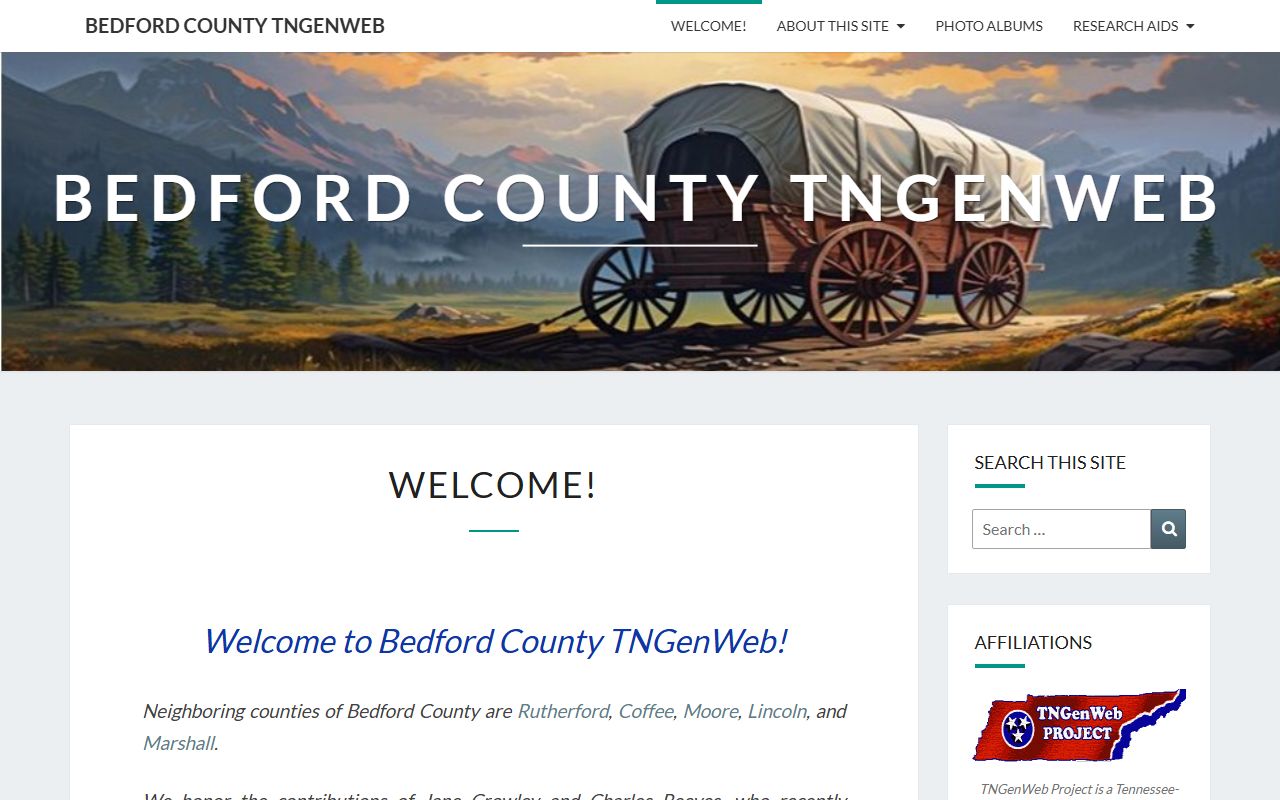
That page is useful when you need a probate index or a quick name clue before you call the courthouse. The county fees in the research are also simple, and state vital record fees apply when you need a birth, marriage, or divorce record copy. That matters because some Bedford County families are easier to trace through state certificates than through damaged county books. Note: Bedford County's burned records make exact dates especially useful, so write down every small clue before you request a copy.
The second image source comes from the Tennessee Genealogical Society county data page at tngs.org/resources/Site/Custom_HTML_Files/TCD/County/Bedford.html. It is a good backup when you want a county-level reference that sits outside the courthouse system.
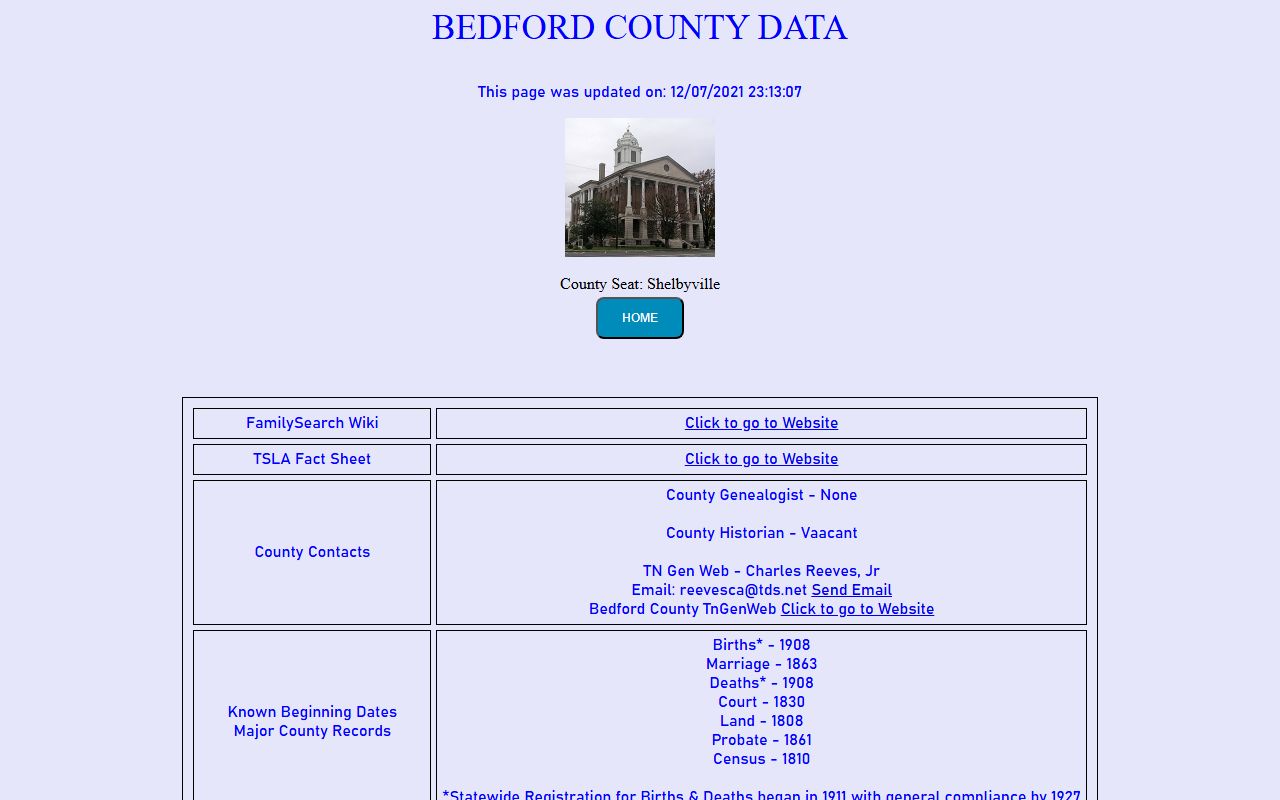
That kind of resource is especially useful in a county where losses forced later researchers to rebuild the trail from scraps.
Bedford County Genealogy in Libraries and Societies
The Shelbyville-Bedford County Public Library is one of the best local stops. The research lists it at 220 South Jefferson Street, Shelbyville, TN 37160, with a phone number of (931) 684-7323. It holds local history and genealogy materials. The Bedford County Historical Society is another useful support. The research notes place it at P.O. Box 141, Shelbyville, TN 37162, and say it publishes a Bedford County historical quarterly. Those smaller print sources matter because they often carry family notes, transcription work, and short articles that do not fit in a formal index.
TSLA remains essential here. The research points to microfilm for deed indexes, chancery records, county court minutes, marriages, and will books. TSLA also holds published local records like land deed genealogies, will indexes, and reconstructed deed indexes. When a family line disappears from the courthouse shelf, TSLA is often where the missing thread comes back into view.
Bedford County Genealogy work is also helped by statewide marriage and death indexes. The county research cites Tennessee State Marriages on Ancestry, Tennessee County Marriages at FamilySearch, and Tennessee Deaths at TSLA. Those state-level tools are not a replacement for the county books, but they are a strong way to test a name before you spend more time on site.
Bedford County Genealogy Online
Online Bedford County Genealogy research works best when you combine the county page, TSLA, and statewide databases. The Bedford County TNGenWeb page is especially valuable because it includes probate indexes, land deed genealogy abstracts, and marriage records. That content can save time when you are trying to see whether a surname belongs in the county at all.
The county's deed books survive better than some other series, so land work is often the cleanest online path. If you know a surname and a rough time frame, start with the deed abstract material, then compare that with the marriage and probate records. That sequence can show how one family moved, divided land, or passed property to the next generation.
The state side matters too. The Tennessee State Library and Archives has the microfilm that preserves many Bedford County records, while the FamilySearch Tennessee records page can pull in county marriages and related record sets. The Tennessee Office of Vital Records is also useful for later marriage and divorce certificates when you need a clean, state-issued copy.
Many Bedford County family lines appear in newspaper abstracts and church records before they appear in a neat courthouse summary. That is normal for this county. The record loss makes the search wider, but it also makes the surviving clues more valuable.
Getting Copies and Working Around Loss
Bedford County Genealogy requests should be direct. Give the office the exact name, record type, and approximate date if you know it. The research says mail requests are accepted and usually turn around in about 5 to 10 business days. In person, available records can be immediate. That makes Bedford a good county for focused requests, even when the older books are gone.
Because the county lost so much early material, you may need to build a family timeline from several places at once. Use the surviving deed run to anchor the family, then check wills, marriages, and court minutes for the same names. If one record type is missing, do not stop there. A church record or a newspaper abstract may carry the same proof in a different form.
Bedford County research rewards patience. The record losses are real, but the county still has enough surviving material to rebuild a solid family line. The key is to keep the courthouse books, TSLA microfilm, and local society notes in the same search plan.