
Campbell County Genealogy Sources
Campbell County genealogy research is shaped by loss and survival. The county was formed in 1806, and two courthouse fires, one in 1883 and one in 1926, did serious damage to the paper trail. That means the search often starts with what still exists, then widens into local histories, church notes, and Tennessee state collections. The county seat at Jacksboro still gives you a clear place to begin, but a strong family search in Campbell County usually needs more than one office. County staff, the historical society, the public library, and TNGenWeb all help fill the gaps.
Campbell County Genealogy Records
Campbell County has a clear set of core records, but the dates matter. The county clerk keeps marriage records from 1838 and probate records from 1806. The register of deeds holds land and deed records from 1820, but there is no online searchable database, so in-person work still matters. That split between online and on-site research makes Campbell County a county where a good plan saves time.
Record loss is part of the story here. The county lost the 1810 and 1820 censuses and also lacks marriage records from 1806 through 1837. That does not end the search, but it does change the route. You may need to move from one record type to another, or from county records to state and private collections. Campbell County genealogy work rewards patience.
When the county files run dry, look at nearby family clues. A deed can place a household on a map. A probate file can name heirs. A marriage book can connect two lines. Those are the kinds of short steps that still move a Campbell County search forward.
Good Campbell County starting points include:
- County clerk marriage records from 1838
- County clerk probate records from 1806
- Register of deeds land and deed records from 1820
- Campbell Historical Society books and microfilm
- Jacksboro Public Library local history materials
Campbell County Courthouse Fires
The courthouse fires in 1883 and 1926 shape almost every Campbell County family search. The county lost much of its early paper trail, so a direct run at the courthouse can leave gaps if you do not know what survived. The biggest missing pieces are the censuses for 1810 and 1820 and the marriage records from 1806 to 1837. Those gaps are real, and they matter.
That said, not all is lost. The county clerk still handles probate records from 1806, and the register of deeds still has land and deed books from 1820. Those records can stand in for missing marriages when a family moved, inherited land, or settled an estate. A single deed can sometimes do the work of two lost books.
In Campbell County, the best research habit is to compare the surviving book with a second source. TSLA microfilm, local books, or a church or cemetery note may confirm the same family and save you from chasing a burned gap.
Fire loss changes the search, but it does not cancel it. The county record set still gives enough to build a family line if you work each clue one at a time.
Campbell County Genealogy Library
The Campbell Historical Society is one of the most useful local stops for Campbell County genealogy. Its books on local history and genealogy, plus microfilm of court records, deeds, marriages, and census schedules, give you material that can sit between the courthouse and the state archive. It also holds back issues of the LaFollette Press, which can add names, dates, and family links that are hard to find in the official books.
Jacksboro Public Library is another practical stop. It does not replace the courthouse, but it helps you sort names before you drive, mail, or call. In a county with heavy record loss, even a short book note can point you to the right branch or place name.
The Campbell County Historical Society at TNGenWeb also helps carry the local work online. The page includes deed book references, surveyor's entries, and a deed submission form. That mix of public and volunteer material can give you a fast edge when the courthouse books are thin.
The image below points to the county TNGenWeb page, which is a useful local gateway for Campbell County genealogy.
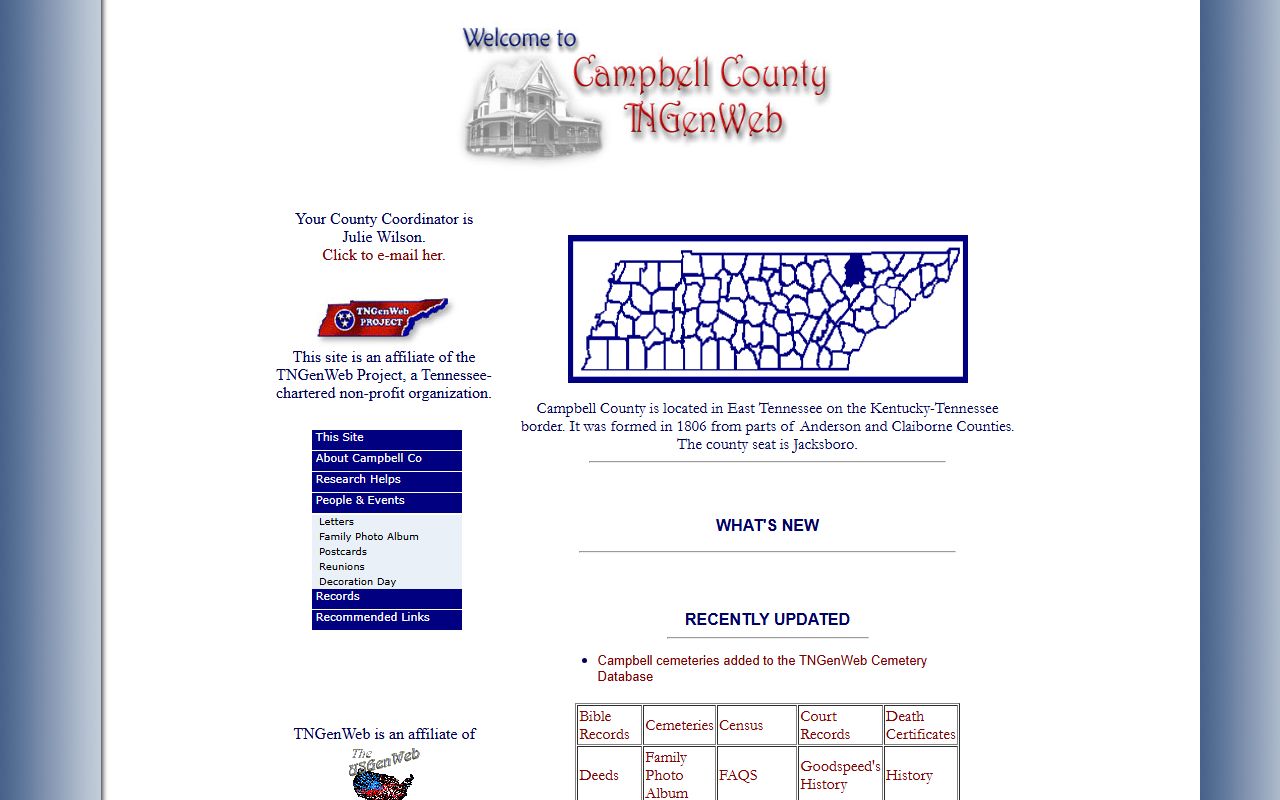
Use that local page when you need a quick deed clue or a helper line before you work the courthouse books.
Campbell County Genealogy Online
Online research helps most in Campbell County when you need a first pass before an office visit. The county does not have an online searchable deed system, so state and volunteer sites do more of the heavy lifting. Start with TNGenWeb, then move to TSLA, TeVA, and FamilySearch Tennessee. Those sites can show whether a name already appears in an index, a book note, or a scanned record.
The broader state collections matter too. the Tennessee Genealogical Society gives access to family and local history material, while Tennessee Electronic Library can open census and local history tools for residents with library access. If you are tracing a line across county lines, those sites can save a long drive.
Campbell County's missing early marriage books make the online route even more useful. When the county record is gone, a state index, a cemetery note, or a newspaper clipping may be the first solid proof you find.
The Campbell County TNGenWeb page is especially good for deed and survey leads, and it keeps the search local even when the paper trail is not.
Campbell County Family History
Campbell County genealogy often works best as a chain of small proofs. A probate file can name children. A deed can place a family on a road or creek. A church or newspaper note can confirm a marriage when the county book is gone. In this county, the chain matters more than any one page.
The county clerk, register of deeds, historical society, and Jacksboro library each cover a piece of the search. Together they give you a wider reach than the courthouse alone. If you start with one surname and stay open to side branches, you can still build a clean family line in Campbell County.
State resources are the best backup when the county papers stop. TSLA, FamilySearch Tennessee, and the Tennessee Genealogical Society all give Campbell County researchers a wider net. That matters in a county with burned records, because the missing book often turns up in a different collection.
Note: Campbell County's 1883 and 1926 courthouse fires make record loss a real issue, so check county, local, and state sources before you treat a blank as a dead end.