
Carter County Genealogy Research
Carter County genealogy work can go deep fast because the county keeps a long run of records and several strong local collections. The county seat in Elizabethton still anchors the courthouse search, but the city archive, the public library, ETSU's archives, and state collections give the county a much wider reach. A 1933 courthouse fire damaged many records and destroyed some early deed books, so the search is not always neat. Even so, the county still offers marriage, probate, divorce, land, and court material that can carry a line back into the late 1700s and early 1800s.
Carter County Genealogy Records
The Carter County Register of Deeds has online real estate and deed records, and its land records go back to 1795. The circuit court clerk keeps divorce and court records from 1804. The county clerk records marriages from 1790, probate from 1800, and county-level birth and death records from 1881. That is a strong set of local records for a county with an early start.
Those dates matter because Carter County has a long paper trail. A marriage can show up before a deed. A probate file can name children. A land book can show a family place long before a modern map does. The best Carter County genealogy searches use all three, not just one.
The county's online deed access is helpful, but the real value comes when you pair it with court and archive material. That gives you a fuller line, and it is often the only way to bridge a fire gap or a missing early book.
Useful Carter County starting points include:
- Marriage records from 1790
- Probate records from 1800
- Divorce and court records from 1804
- Land records from 1795
- County birth and death records from 1881
Carter County Courthouse Loss
The 1933 courthouse fire damaged many Carter County records, and some early deed books were destroyed. The county also lost the 1810 and 1820 censuses. That means an early family may be present in one source and missing in another. The gap is real, but it can be worked around.
Start with the surviving record types, then move outward. Deeds, probate files, and marriage books can all lead to the same household from different angles. If you are stuck, the county archive, the public library, or ETSU may have the extra note you need. In Carter County, one good side source can be worth a lot.
Family lines here often run through Elizabethton and the wider Watauga country, so place matters as much as surname. That makes the county archive and the city archive especially useful when you are trying to match the same family across years.
The fire changed the search, but the county still holds enough to support a strong line study.
Carter County Genealogy Archives
The Carter County Archives is still a work in progress, and its physical holdings are limited. Even so, the digital holdings at USGenWeb Archives give researchers another useful entry point. That is especially important when a name needs a quick cross-check before a courthouse request.
The Carter County TNGenWeb page is listed as adoptable, but it still represents a useful county-level lead. Along with the archives page, it helps direct the search toward local names, places, and record clues that fit Carter County itself. The county archive and its digital holdings work best as a bridge between the courthouse and the library.
The image below points to the Carter County TNGenWeb page, which is a practical starting point for local family research.
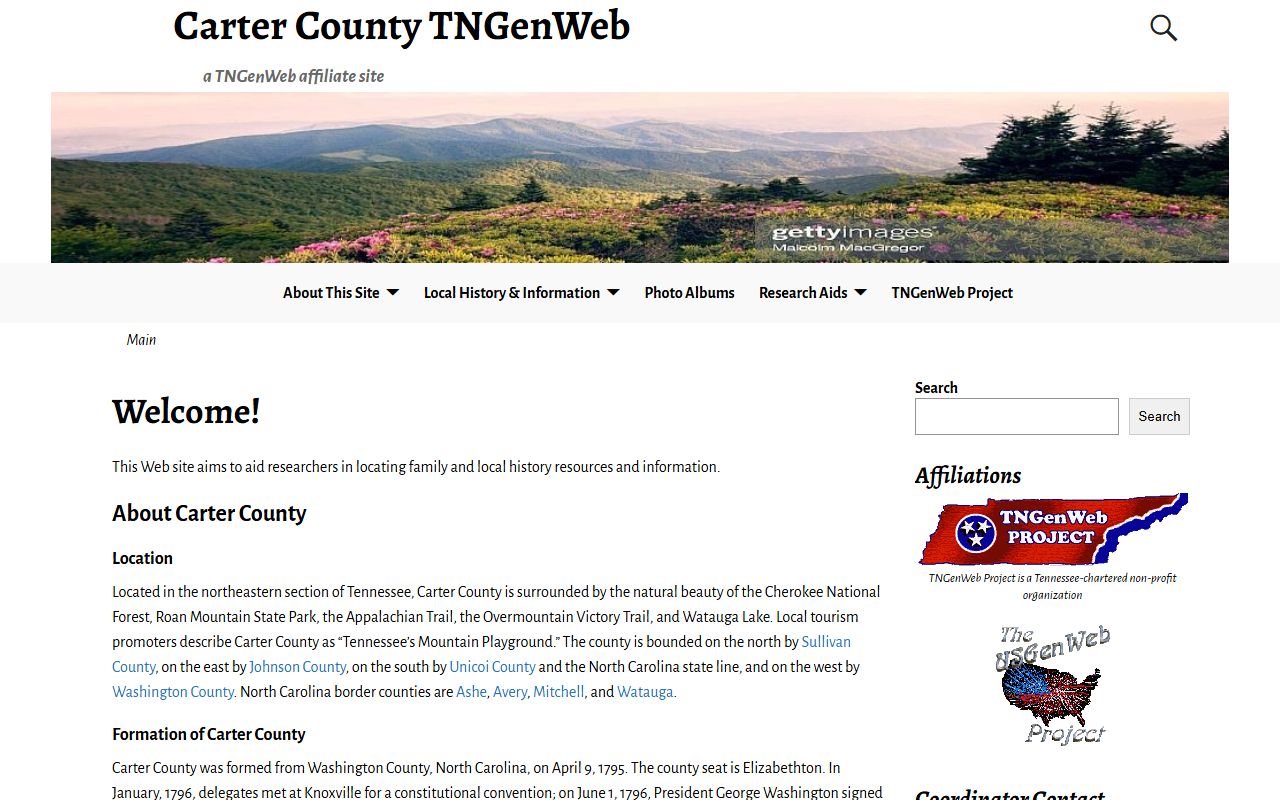
That county page is handy when you want to check a surname, a place, or a record note before asking for copies. In Carter County genealogy, that bridge is often what turns a hint into a proof.
Carter County Library Sources
The Elizabethton and Carter County Public Library has an archive of the city of Elizabethton and a wide set of local materials. Its holdings include family and local histories, county and city records on microfilm from the 1790s through the 1970s, photographs, maps, scrapbooks, city directories, yearbooks, rayon plant documents, and the Elizabethton Star on microfilm from 1838 to the present. That is a strong stack for local family work.
The library also offers research help. The archivist works part time, so calling ahead helps. Copies are 10 cents a page and microfilm prints are 25 cents a page. That is small, but it is useful to know before you sit down to work a stack of notes.
The Archives of Appalachia at East Tennessee State University is another major Carter County source. Its holdings are huge, and the collection includes manuscript files, oral histories, photographs, and audiovisual material that support broader East Tennessee family searches.
The library and ETSU together give Carter County researchers a strong pair of local and regional sources. That makes the county easier to work than the fire loss might suggest.
Carter County Genealogy Online
Online Carter County research works well when you start with the county pages, then move to state and regional support. Use the Carter County TNGenWeb page and the USGenWeb Archives first, then check TSLA, TeVA, and FamilySearch Tennessee. Those sources are the fastest way to spot a name before you make a trip.
State tools matter too. The Tennessee Genealogical Society can help with compiled family work, and Tennessee Electronic Library can open history tools for residents with library access. If you need a later record copy, Tennessee Vital Records Online adds another path into the state system.
Carter County also fits a regional search through the East Tennessee Historical Society. That is helpful when a family moved through the mountain counties and left clues in more than one place.
That mix of county and state tools is the fastest way to narrow a Carter County line before you ask for copies.
Carter County Family History
Carter County genealogy works best when you keep the line broad. A marriage, a probate file, a deed, and a newspaper note can all sit on the same family. When one piece is weak, the others can still carry the proof. That makes the county's local library and archives especially helpful.
The Watauga Association of Genealogists and the archives of Appalachia add more depth to the regional search. They can support a line that crosses into nearby East Tennessee counties or reaches into the older Watauga settlement pattern. That is one reason Carter County remains a strong research county even after fire loss.
Note: Carter County's fire loss makes the library, the archive, and the state collections part of the main search, not just backup sources.