
Clay County Genealogy Search
Clay County genealogy research is direct and usually pleasant. The county reports no known courthouse disasters, so the local paper trail is unusually solid for this part of Tennessee. That means you can move from a marriage book to a deed, then to a probate file or court minute without having to rebuild the whole search from scratch. Start in Celina with the county courthouse, the public library, and the museum. Then use TNGenWeb, TSLA, and state vital records for backup or for older family connections. The best searches here are steady, simple, and specific.
Clay County Genealogy Records
Clay County keeps a fairly complete set of core records from the late 1800s and early 1900s. The courthouse books cover the main life events a family researcher needs. That includes marriages, probate matters, court work, land transfers, and the civil records that came later. If you are trying to prove a family line or connect two households, the county record run gives you a strong chance of finding a name in one place and a date in another.
The record dates matter here because they tell you what to expect at the courthouse and what may need a state copy or microfilm backup. Clay County is one of those places where the local books are the main story, not the exception. That makes the county clerk and the register of deeds very important to the search.
- Marriage records from 1870
- Probate records from 1870
- Court records from 1870
- Divorce records from 1870
- Land records from 1871
- Birth and death records from 1908
Because the record set is complete, Clay County can be a good place to test a research habit. Start with the marriage record, then use land and probate to test the same family. If the names line up, you have a path. If they do not, you can still learn which branch of the family stayed in the county and which one moved on.
Clay County Genealogy Sources
Clay County has no active county archives, so the local library and museum matter more. The Clay County Public Library has a genealogy collection that mixes local and family history. The Clay County Museum of History adds another layer and can help with place names, old families, and county memory. Together, those two stops give you the kind of local context that turns a name into a family story.
The Clay County TNGenWeb page at Clay County TNGenWeb is a strong first link. It points to marriage records, cemetery records, census records, military records, and family surname resources. That list works well with a county that has solid books, because it helps you test the same family across more than one source. It also gives you a place to look when a surname is common and the courthouse page alone does not tell you which person is yours.
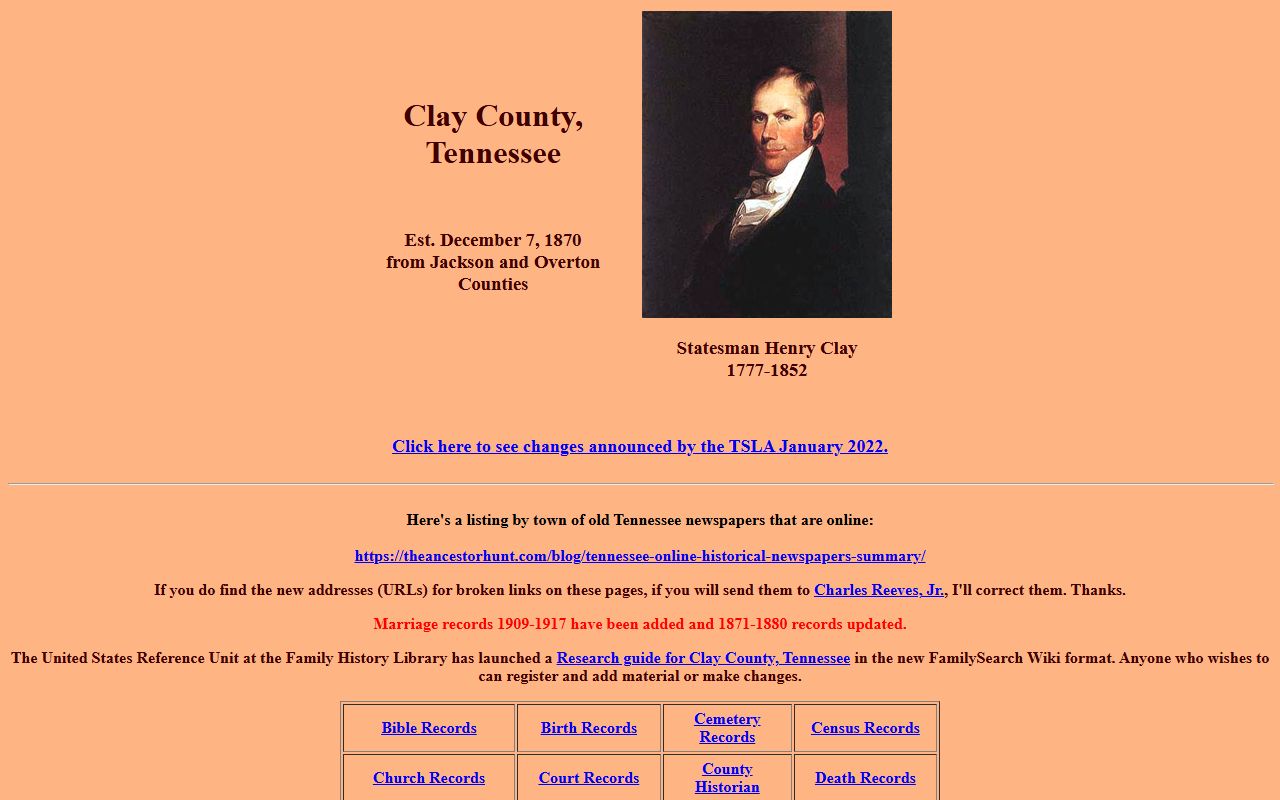
That county page is useful when you need cemetery and surname clues before you open a courthouse book.
The Clay County TNGS data page at Clay County TNGS Data adds a second research track. It is a practical place to compare surnames and to widen the search when a family moves through the Upper Cumberland region. Clay County tends to reward careful comparison, and this source helps with that job.
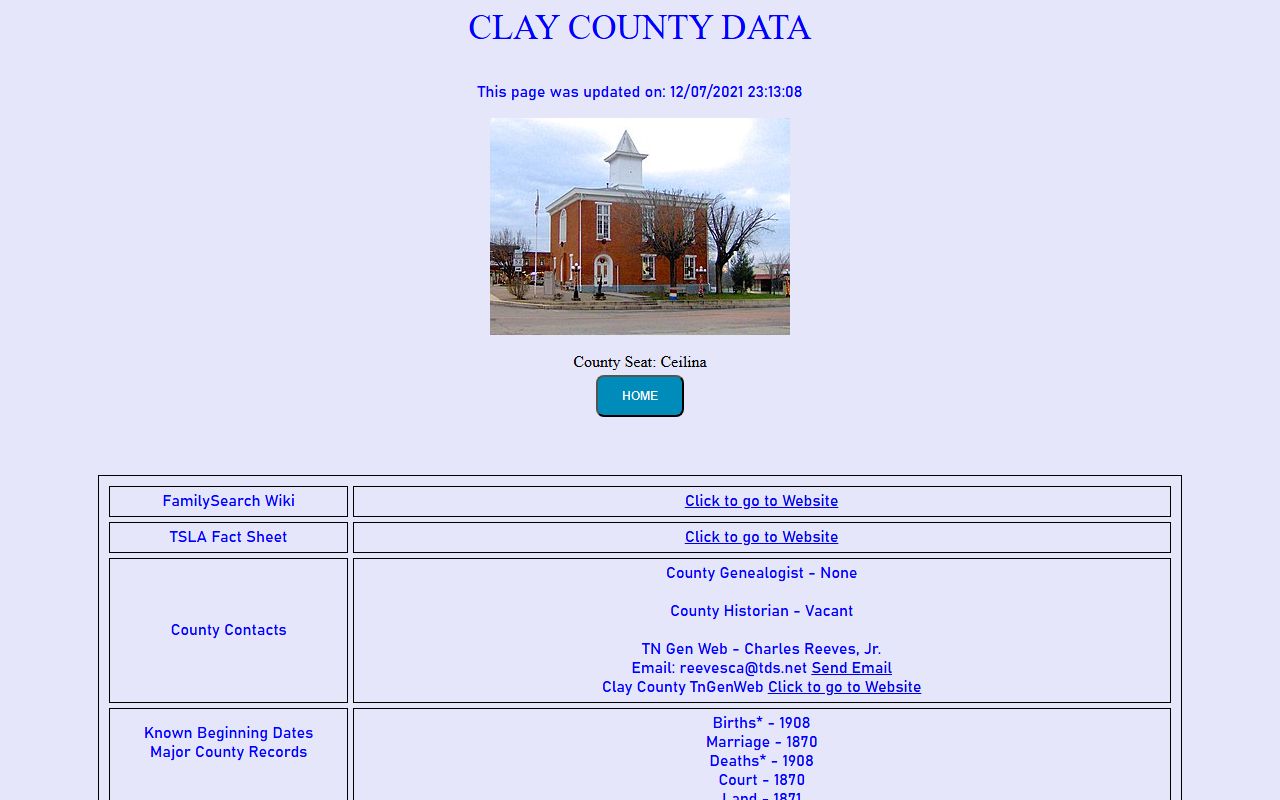
That page helps you compare local names with a broader Tennessee family web.
Searching Tennessee Genealogy Sources
Clay County fits neatly into the larger Tennessee research system. TSLA is a good backup when you want microfilm, state copies, or a book that sits outside the county office. The Tennessee Virtual Archive can help with digitized images and searchable collections. The Tennessee Office of Vital Records gives you a modern civil record route for births, deaths, marriages, and divorces. Together, those sources cover the county from several angles.
FamilySearch is also worth a stop for Clay County because it can help you compare county names, families, and dates against a state-wide search. The Tennessee Genealogical Society is a useful broad support site as well, especially if you want context for Upper Cumberland families. None of these sites replaces a county book. They just make the county book much easier to use.
Helpful links for Clay County research include TSLA, TeVA, Tennessee Office of Vital Records, TNGenWeb, FamilySearch Tennessee, and Tennessee Genealogical Society. TSLA is the place to check when you need a backup book. Vital Records is the place to check when you need a certified civil copy. The other sites help you sort the family line before you walk into the courthouse.
Clay County also has published cemetery work that can be useful when a family is hard to pin down. The two-volume Cemeteries of Clay County, Tennessee set gives you another route into surnames and burial places. That kind of source is very helpful in a county where you already have good record survival and just need one more clue to connect the dots.
Plan a Clay County Visit
Celina is the county seat, and the courthouse is easy to work with if you arrive prepared. The Clay County Courthouse is at 145 Cordell Hull Drive, and the county court offices each have their own phone number. The courthouse hours are Monday, Tuesday, and Thursday from 8 a.m. to 4 p.m. That schedule matters, so plan your visit carefully. If you only have one day, call ahead and make sure the office you need will be open.
For record work, the county clerk, circuit court clerk, chancery court clerk, and register of deeds each serve a different purpose. The register of deeds handles land records from 1871, while the county records also cover marriage, probate, court, and divorce. If you are not sure where to begin, start with the record type and the date. That will usually point you to the right desk fast.
- Full name and spelling variants
- Approximate date or decade
- Record type, such as deed, marriage, probate, or divorce
- Any spouse, child, or parent name
- Any cemetery or town clue
Note: Clay County is a good place to compare courthouse records with cemetery books and local history material, because the county record run is unusually complete.